


There is no single immigration adviser cost in the UK. What you pay depends on the visa route, how complicated your circumstances are and how the adviser structures their fees. This guide explains where the money goes, how immigration adviser cost is usually set, what a fair quote should include and the warning signs that a cheap offer may cost you more in the end.
- Most applications involve three separate costs: the adviser’s fee, the Home Office fee and, for longer visas, the Immigration Health Surcharge.
- Government fees are the same whoever helps you. Only the professional fee varies between providers.
- A fixed fee agreed in writing is the easiest way to know your total cost upfront.
- Always check that the adviser is regulated before you pay anything.
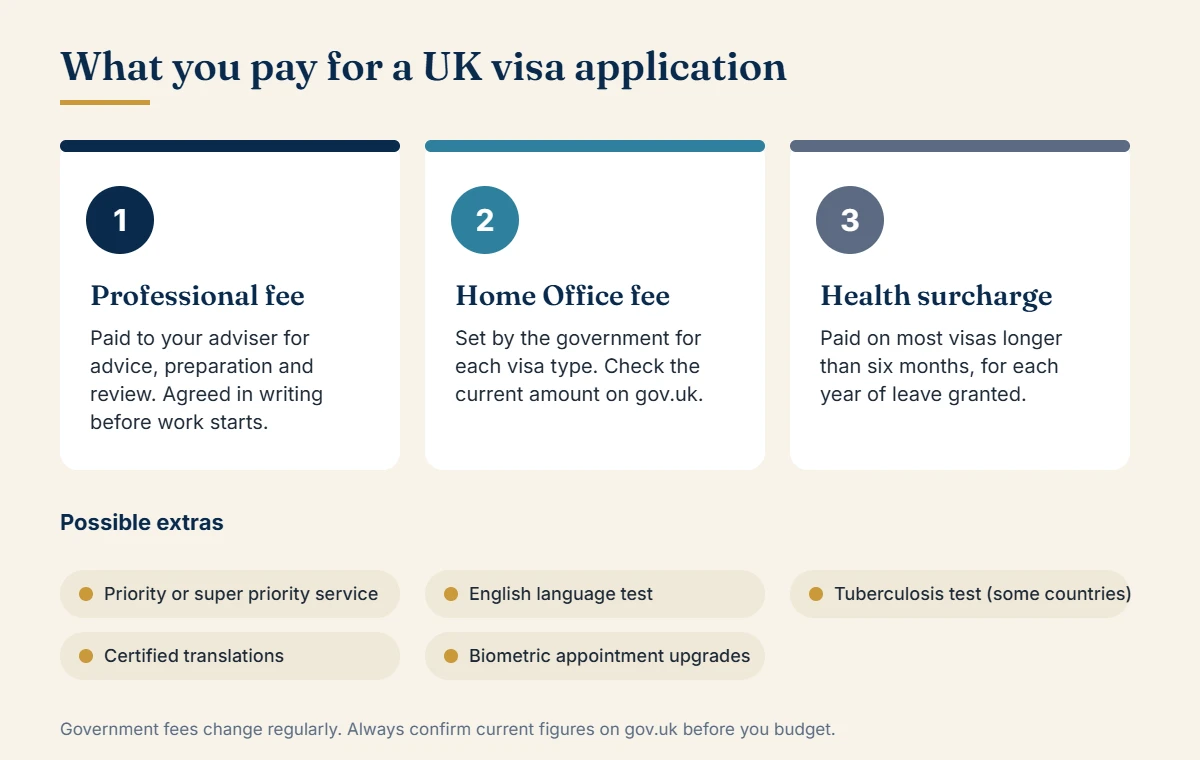
The three costs in a UK visa application
It helps to separate what you pay your adviser from what you pay the government, because quotes are not always presented the same way.
1. The professional fee
This is what you pay a regulated adviser or solicitor to assess your case, prepare the application, check your evidence and deal with any follow-up from the Home Office. It is the only part of the cost that changes depending on who you choose.
2. The Home Office application fee
Every visa, extension, settlement or citizenship application has a government fee set by the Home Office. The amount depends on the route and on whether you apply from inside or outside the UK. Fees are reviewed regularly, so check the current figure on gov.uk’s fee tables before you budget.
3. The Immigration Health Surcharge
Most people applying for a visa of more than six months must pay the Immigration Health Surcharge, which gives access to the NHS. It is charged for each year of leave and paid upfront when you apply. Some routes, such as the Health and Care Worker visa, are exempt.
How immigration advisers charge
- Fixed fee: one agreed price for a defined piece of work, such as preparing a spouse visa application. This is the most predictable option.
- Hourly rate: you pay for the time spent. This can suit unpredictable cases, but makes the final cost harder to estimate.
- Staged fees: a fixed price split into stages, for example an initial assessment followed by full preparation.
- Free first assessment: many firms, including IAUK, offer a short free consultation so you know your options before committing.
What affects the immigration adviser cost for your case
Two people applying for the same visa can receive quite different quotes. The main reasons are:
- the complexity of the route and how much judgement the case needs;
- any previous refusals, overstays or gaps in your immigration history;
- the number of dependants included in the application;
- how much evidence must be gathered, checked or translated;
- urgency, for example when a visa is about to expire; and
- whether the matter involves an appeal or administrative review.
As a rough guide across the UK market, a simple document check usually costs a few hundred pounds, while full preparation of a complex application or an appeal can run into the low thousands. A detailed written quote for your own situation is far more useful than any average.
What a fixed fee should include
Before you agree, ask exactly what the price covers. A clear quote normally lists:
- an eligibility assessment and advice on the right route;
- a tailored document checklist;
- review of your evidence and preparation of the application forms;
- a cover letter or legal representations where needed;
- submission support and handling of Home Office requests; and
- a clear statement of what is not included, so there are no surprises.
Red flags to watch for
- The person cannot show you their IAA registration or solicitor’s practising details.
- They guarantee that your visa will be approved.
- They will not put the fee and the scope of work in writing.
- They push you to pay in cash or to decide on the spot.
- They suggest leaving out or changing information on your application.
Giving immigration advice without being regulated is a criminal offence in the UK. You can check an adviser on gov.uk’s find an immigration adviser service, and our guide to the difference between an IAA adviser and a solicitor explains what to look for.
Is the cheapest option a false economy?
It can be. If an application is refused, the Home Office fee is usually not returned, and you may need to start again with fresh evidence and a new fee. Time matters too: a refusal can leave you waiting months or affect future applications. Paying for careful preparation once is often cheaper than paying for a second attempt.
How IAUK prices its work
At IAUK, your advisory fee is confirmed in writing before any work starts, and Home Office fees and the Immigration Health Surcharge are listed separately so you see the full cost. Typical routes we handle include spouse visas, Indefinite Leave to Remain, Skilled Worker visas and sponsor licences.
Get a clear quote for your case
Tell us about your situation and an IAA-regulated adviser will explain your options and the full cost, with no obligation.
Frequently asked questions
How much does an immigration lawyer cost in the UK?
Immigration solicitors and IAA-regulated advisers usually charge either a fixed fee per application or an hourly rate. What you pay depends mainly on how complex your case is, not on the professional’s job title. Ask for a written quote that sets out what is included, and remember that Home Office fees and the Immigration Health Surcharge are paid on top. You can visit our Manchester office or speak to us remotely for a fixed-fee quote.
Is the first consultation free?
Many advisers offer a free initial assessment. At IAUK the first assessment is free and there is no obligation to go ahead.
Do I get the Home Office fee back if my application is refused?
Usually not. Application fees are generally non-refundable, although the Immigration Health Surcharge is normally refunded if the application is refused.
Are adviser fees cheaper than solicitor fees?
Not necessarily. Prices depend on the firm and the complexity of the case. Compare written quotes from regulated providers and check what each one includes.
Last reviewed: October 2026. Government fees change regularly; always confirm current amounts on gov.uk.